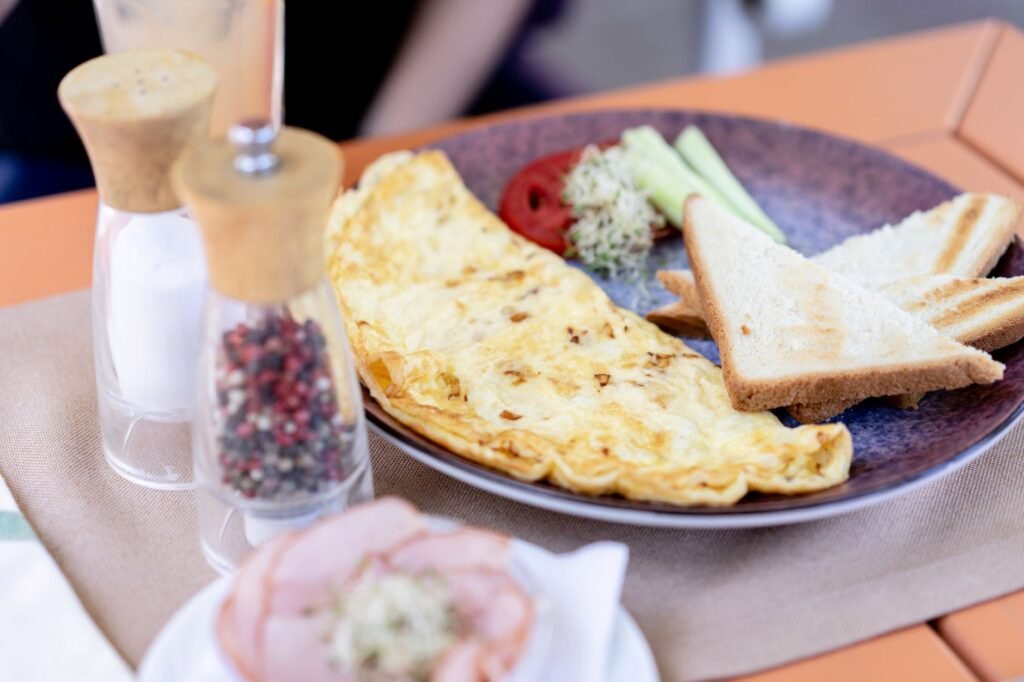
A French omelette is beaten eggs cooked in butter over moderate heat, stirred constantly until they form soft curds, then rolled into a smooth pale cylinder before any browning appears. The whole cook is quick, so have the plate, the butter and any filling ready before the eggs touch the pan.
How a French omelette differs from diner and skillet styles
Omelette covers a whole family of egg dishes, and the French version is the fussiest of them. The outside should stay pale yellow and silky, while the center is left soft and slightly creamy, a texture French cooks call baveuse. Other styles aim for something quite different.
| Style | Surface | Center | How it is finished |
|---|---|---|---|
| French | Pale, smooth, no color | Soft and creamy | Rolled or folded in thirds |
| American diner | Lightly golden | Cooked through | Folded in half over fillings |
| Frittata | Browned top and bottom | Firm | Served flat, often in wedges |
| Spanish tortilla | Golden | Firm, thick with potato | Flipped and served in slices |
Because the finished roll has nothing to hide behind, every slip shows, whether that is a brown patch, a dry edge or a tear. That also makes it a good dish for learning heat control.
Beating the eggs and warming the butter
Two or three eggs make one serving and fit a small nonstick skillet. Crack them into a bowl rather than the pan, so stray bits of shell are easy to fish out, and beat them with a pinch of salt until no streaks of white remain, since stray bits of white cook into rubbery patches that spoil the smooth finish. A fork is enough, though some cooks push the mixture through a strainer for an even silkier result.
Melt a pat of butter over medium heat and tilt the pan so it coats the sides. Watch the foam. When it settles and the butter is hot but not yet browning, the pan is ready.
Stirring, shaking and rolling the eggs
- Pour in the eggs and immediately stir with a silicone spatula or the back of a fork while shaking the pan back and forth.
- Keep stirring until small curds form throughout and the mixture looks like very wet scrambled eggs.
- Stop stirring and spread the eggs into an even layer so a thin skin sets underneath.
- While the top is still glossy, tilt the pan away from you and nudge the near edge over toward the center.
- Slide the omelette to the far edge, then roll it out onto the plate seam side down.
If the eggs start to color, pull the pan off the burner for a few seconds. Heat can always be added back, but browning cannot be undone.
The roll takes practice. If the first few tear or come out lopsided, fold the omelette in thirds on the plate instead. It tastes exactly the same, and the motion starts to feel natural after a few mornings at the stove.
Fillings that fit inside a thin roll
A French omelette is thin, so fillings need to be small and already cooked. Finely chopped chives, parsley or tarragon can go into the beaten eggs. Grated cheese, sauteed mushrooms or a spoonful of soft herbed cheese go in a line down the middle just before you roll.
Keep the amount modest. A heavy filling tears the skin and pushes out the soft center, and wet vegetables leak water that makes the eggs weep on the plate. A brush of soft butter over the finished roll gives it the glossy look you see in restaurant photos.
Soft centers and egg safety at home
The creamy center means part of the egg stays below the point where it is fully set. The FDA advises cooking eggs until the yolk and white are firm and suggests pasteurized shell eggs or egg products for recipes that leave eggs undercooked.
The advice counts most for young children, older adults, pregnant people and people whose immune systems are weakened. For those diners, use pasteurized eggs or cook the omelette a little longer until the center is set. Keep the raw eggs refrigerated right up until you crack them for the omelette.
Frequently asked questions
Should I add milk or cream to a French omelette?
Classic French omelettes use only eggs, salt and butter. Milk or cream thins the mixture and can make it weep liquid on the plate. If you want extra richness, a small knob of cold butter stirred into the beaten eggs does the job without adding water.
Can I make a French omelette in a stainless steel pan?
You can, but it takes more butter and steady heat control, since eggs stick easily to bare steel. A seasoned carbon steel pan or a nonstick skillet gives you a cleaner roll with less practice. Whatever pan you use, heat it evenly before the eggs go in.
Why did my omelette turn out brown and dry?
The pan was too hot or the eggs sat too long before you stopped stirring. Lower the heat a notch next time and keep the eggs moving until curds form. Pull the pan off the burner as soon as any color appears on the bottom.
How do you make a fluffy omelet?
Beat the eggs until fully blended, cook them in butter, and gently push the set edges toward the center so raw egg can flow onto the pan. Fold it in half once no liquid remains on top. For the puffiest version, a soufflé omelet, beat the whites stiff, fold in the yolks and finish it in the oven.
What is a Denver omelet?
A Denver omelet, which Merriam-Webster lists under its other name, western omelet, is an American omelet made usually with diced ham, green pepper and onion. It is usually cooked through and folded over the filling, diner style, so it looks nothing like the pale, soft French roll described above.