
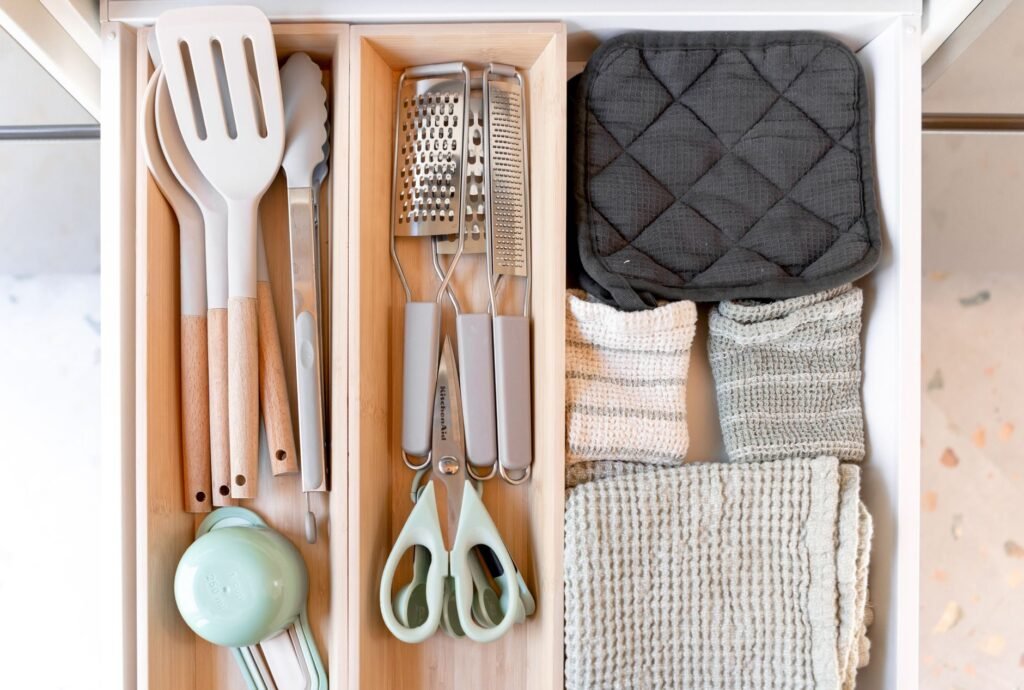
To organize kitchen drawers, empty them, get rid of duplicates and things you never use, then give each drawer one job based on where in the kitchen you use its contents. Add dividers sized to your drawers, and keep everyday tools in the drawers that are easiest to reach.
Emptying kitchen drawers before buying any organizer
Organizers bought first tend to fail, because they get sized to the clutter instead of to what you use. Empty one drawer at a time onto the counter and wipe out the crumbs. Sort what came out into piles for weekly use, occasional use, duplicates, and things you cannot remember using.
Duplicates are where most drawers overflow. Three can openers, five spatulas and a nest of takeout chopsticks take up space your daily tools need. Keep the best one or two of each. The occasional pile, such as a baster or pastry cutter, can move to a less convenient drawer or a cabinet.
Measure each drawer’s inside width, depth and height before you shop. The drawer box is often smaller than the front suggests, and a tray a fraction too wide will not fit at all.
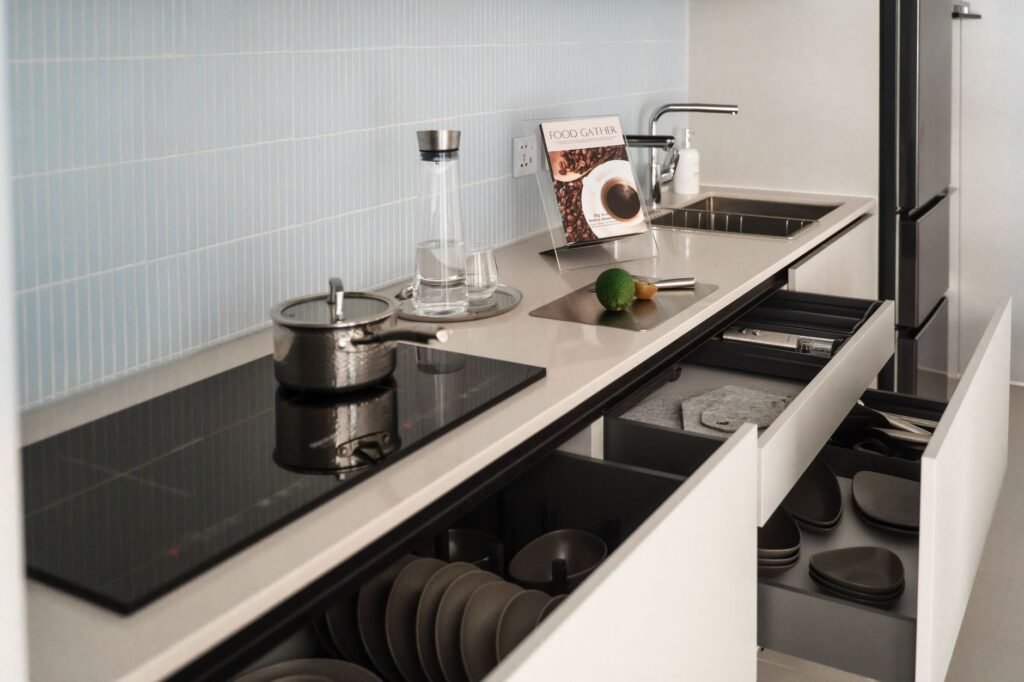
Giving each kitchen drawer a zone
The drawer closest to where a task happens should hold that task’s tools. Think about the kitchen in zones.
- Beside the stove, cooking utensils such as spatulas, tongs, wooden spoons and pot holders.
- At the main prep counter, knives in a protective dock, measuring cups and spoons, peelers and graters.
- Near the dishwasher or sink, everyday flatware, so unloading takes only a few steps.
- Close to the fridge or a lunch packing spot, food wraps, bags and small storage containers.
- In a low or out of the way drawer, rarely used gadgets and backup supplies.
Your layout may not allow every zone. Give priority to flatware and cooking tools, since those drawers open the most times each day.
Kitchen drawer organizers compared
| Organizer | Good for | Limitation |
|---|---|---|
| Expandable flatware tray | Top drawers with forks, spoons and table knives | Fixed slots may not suit odd shaped tools |
| Adjustable divider strips | Utensil drawers with long tools | Can shift unless wedged tightly |
| Small modular bins | Gadgets and junk drawer items | Many pieces to arrange |
| In-drawer knife dock | Kitchen knives | Needs a drawer long and deep enough |
| Pegboard drawer insert | Plates and bowls in deep drawers | Needs a sturdy, deep drawer |
| Upright rack | Lids, sheet pans, cutting boards | Uses up drawer height |
Loose knives rattling around a drawer dull quickly and can cut you when you reach in. A dock or block protects both the blades and your fingers, and a separate guide covers how to sharpen kitchen knives that have already lost their edge.
Deep drawers for pots, lids and food containers
Deep drawers hold heavy things well, but they turn into piles fast. Store pots and pans in a single layer if you can, or nest them by size with a paper towel or pan protector between nonstick surfaces. Stand lids on edge in a rack or between pegs so you can see each one.
Food storage containers are the classic mess. Match every container with its lid and recycle the orphans. Nest containers by shape, and stand the lids upright in a bin or file style divider beside them. Fewer shapes make this far easier, so if you own a mix of sets, keep one.
Heavy cast iron and stacks of plates belong in the sturdiest drawer, usually the one closest to the floor. Check that the drawer slides are rated for the load if you plan to store dishes there.
Keeping the junk drawer from taking over
Almost every kitchen has one, and there is nothing wrong with that. Give it small bins for categories you really use, such as batteries, tape, pens, twist ties and a spare key or two. Toss the rest, including dried out pens, mystery keys and expired coupons.
Drawers stay organized only with a routine. Set a limit for each drawer, so a new gadget means an old one leaves. Every few months, spend ten minutes pulling out anything that drifted in from other rooms. If a drawer keeps overflowing, the fix is usually owning less, not buying another organizer.
Frequently asked questions
What should go in the top kitchen drawer?
The top drawer nearest the dishwasher or main prep area usually works best for everyday flatware, since it opens most often. A second top drawer near the stove can hold cooking utensils. Keep sharp knives in a protective dock rather than loose in any drawer.
How can I organize kitchen drawers without buying organizers?
Use what you already have. Shoeboxes, small food storage containers and cut down cereal boxes make free dividers, and a scrap of shelf liner stops them sliding. Once a layout proves itself, you can replace them with organizers sized to fit, and you will know exactly what to buy.
Should I use drawer liners in kitchen drawers?
Liners are optional. A nonslip liner keeps trays and tools from sliding around and protects the drawer bottom from scratches and spills. Choose one you can wipe clean or wash, and lift it out now and then to clear crumbs trapped underneath it.
How do you remove kitchen drawers?
Empty the drawer, pull it all the way out and look at the slides. Many side mounted slides have a small lever on each side to press while you pull the drawer free, and undermount slides usually have release clips under the front. If it resists, check the slide maker's instructions instead of forcing it.
How can you store kitchen utensils without drawers?
Keep everyday tools upright in a crock beside the stove, and hang ladles, whisks and spatulas from a wall rail with S hooks. A wall mounted magnetic strip holds knives off the counter, and a pegboard or the inside of a cabinet door can hold measuring cups. Keep only what you use often within reach.
How do you babyproof kitchen drawers?
Fit safety latches or locks on every drawer and cabinet that holds knives, sharp tools, cleaners or medicines. The CPSC says these devices help prevent poisonings and other injuries, but they are not a guarantee, so move the most dangerous items up high or into a locked cabinet as well. Test each latch with a firm tug.