
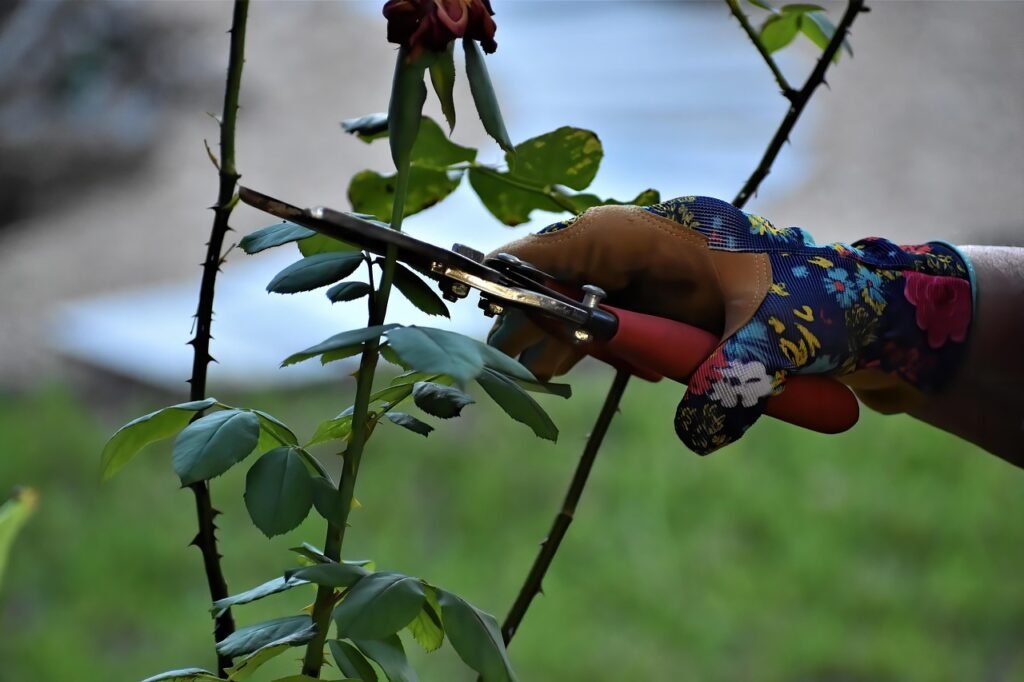
Take rose cuttings from semi hardwood, which is wood that has firmed up after flowering but has not gone fully woody, then root them in a gritty mix under cover. Timing and fungal control decide the outcome. Soft green tips collapse, and fully hardened canes root very slowly if at all.
Semi hardwood is the only stage that reliably roots
Roses are shrubs, not soft stemmed houseplants, and the wood passes through three stages in a season. New spring growth is green, flexible and full of water, and it wilts faster than it can make roots. By late winter the same cane is brown, hard and slow to respond to anything. The productive stage is the one in between.
There is a physical test for it that takes a second. Push a thorn sideways with your thumb. On semi hardwood it snaps off cleanly and leaves a small scar. On green wood it bends and tears the skin of the stem with it, and on hard old cane it will not move at all. Growers rely on this because it reads the stem directly rather than guessing from the calendar.
Spent blooms mark the window better than a date does
The stem that carried a flower reaches the right firmness shortly after that flower fades, so deadheading time and cutting time overlap. A cane still holding an open bloom is usually a little too soft, and one that has already set a hip has often gone past.
- Choose a healthy stem that has just finished flowering and cut a length with several nodes on it.
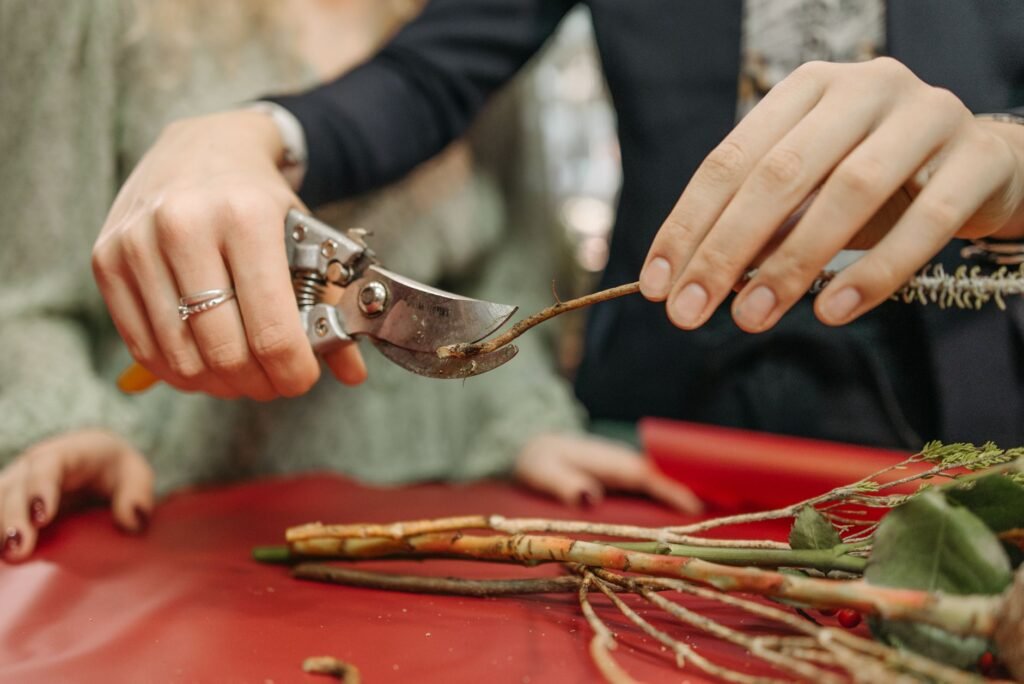
- Trim the base square, just below the lowest node, and slope the top cut above the highest node.
- Strip every leaf from the lower half and remove any remaining flower or hip.
- Halve the upper leaves so there is less surface giving off moisture.
- Get the base into damp mix the same hour you cut it, before the stem seals over.
Cuttings taken in one long session dry out while they wait. Carry a bag or a jar of water into the garden and put each one in as you go.
Humidity without rot is the whole problem with rose wood
A leafy cutting with no roots needs air around it that is nearly saturated, otherwise it loses water faster than the stem can pull it. But rose wood is also prone to fungal problems, so trapping moisture is a balancing act rather than a simple matter of covering the pot.
| Choice | Why it helps |
|---|---|
| Sharp sand or perlite heavy mix | Drains fast so the base never sits in water while the air stays damp |
| Clear cover with a vent gap | Holds humidity around the leaves while letting stale air escape |
| Bright shade, never direct sun | Keeps the cover from turning into an oven on a clear afternoon |
| Clean blade and clean pot | Removes the fungal load that costs most people their batch |
| Spacing between cuttings | Stops one failing stem from spreading rot to its neighbors |
Look the batch over every second or third day and pull any stem that has turned brown and soft at the base. Leaves dropping is not automatically a failure, since a cutting can root and then leaf out again, but a blackening stem is finished.
Patented varieties cannot legally be propagated
Roses differ from most plants a home gardener multiplies, because many modern varieties are covered by plant patents. The protection covers asexual reproduction, which is exactly what a cutting is, and it applies to plants grown for your own garden as much as to plants grown for sale.
Check the tag or the label that came with the plant. Patented varieties carry a patent number, or the letters PPAF while an application is pending, and the wording usually states that propagation is prohibited. Older varieties and species roses whose protection has lapsed are free to take cuttings from, and heritage roses growing in a family garden are the classic case where this method earns its keep.
If the tag is long gone and you cannot identify the variety, a nursery or a local rose society can often place it, and that is worth doing before you build a hedge out of cuttings.
Frequently asked questions
Does the potato trick actually work?
It circulates every spring and it is a poor bet. A potato holds a great deal of moisture against the base of a woody cutting and then starts to ferment, which is close to ideal conditions for rot. A gritty, free draining mix gives the cutting the same steady moisture without the decay.
Will the new plant match the rose I took it from?
The top growth will, since a cutting is a clone. What changes is the root system. Most nursery roses are grafted onto a vigorous rootstock, while yours will grow on its own roots, so it may take longer to reach size and it will regrow true if winter kills it back.
When can a rooted cutting go into the garden?
Wait until roots fill the pot and the plant has come through a full season of growth. Moving a freshly rooted cutting into open ground puts it up against wind, competition and swings in soil moisture that it has no reserves for. Its first winter is safer in a sheltered spot.