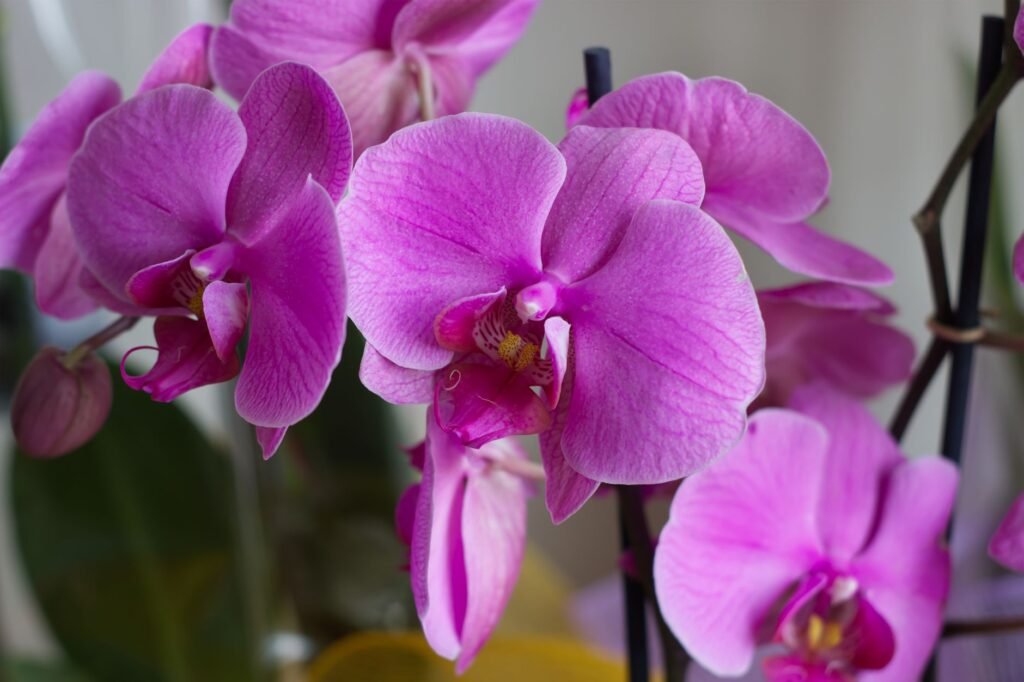
Orchids do not root from a cut length of stem the way a pothos does. Two routes work on a windowsill: detaching a keiki, which is the baby plant an orchid sometimes builds on its flower spike, and dividing a plant that carries several growth points. The usual supermarket moth orchid allows neither on demand.
Why a cut piece of orchid stem will never root
Ordinary houseplant cuttings succeed because a stem hides dormant buds, and the tissue around them can throw both roots and shoots. Orchid stems are built differently. A moth orchid grows from one point in the middle of its leaf fan, and no spare buds sit waiting along a bare stem to restart the plant from scratch.
Flower spikes do carry nodes with sleeping buds, which is why trimming a finished spike above a node sometimes brings a second round of blooms. Those same buds occasionally build a keiki. What they refuse to do is make roots on a severed piece of spike pushed into a pot, because that fragment owns no growing point and no reserve to live on.
| Approach | Suited to | Realistic on a moth orchid? |
|---|---|---|
| Keiki removal | Phalaenopsis, Dendrobium and relatives | Only once the plant volunteers one |
| Rhizome division | Cattleya, Oncidium, Cymbidium | No, those grow sideways instead |
| Stem cutting | Essentially nothing sold as a houseplant | No |
| Seed in sterile flask | Any orchid, in a lab | No |
Keikis are the baby plants an orchid volunteers
A keiki is a complete miniature orchid that appears at a spike node, or low on the stem in some plants. It arrives with leaves, grows roots of its own in time, and is genetically identical to its parent.
- Leave it attached until it carries two or three leaves and at least two roots an inch or longer. Taking it early kills more keikis than anything else.
- Cut the spike roughly an inch above and below it using a sterilized blade, so a short stub stays on either side of it.
- Settle it into fine bark or sphagnum in a small pot, roots spread out, with the crown sitting clear of the mix.
- Hold humidity high and light bright but indirect through the first several weeks.
You cannot order one. Some plants make keikis after a stressful spell or when a spent spike is left in place, and plenty never do. Hormone paste dabbed on a sleeping node works occasionally, though a node that has already dried and shriveled will not answer.
Division needs a plant with more than one growth
Dividing is simple on sympodial orchids, the kind that creep sideways along a rhizome and add a fresh pseudobulb each season. Unpot the plant, shake the bark away, find the rhizome, and cut so every piece keeps three or four sound pseudobulbs with roots attached. Smaller scraps often live, but they sulk for a year or more before flowering again.
The moth orchid on your counter is monopodial. One crown, one stack of leaves, one growing point. Cutting through that point does not give you two plants, it gives you a corpse. If such a plant ever shows two crowns side by side, those are basal keikis, and they come away once they own roots.
Season beats technique here. Split as new growth is starting so each piece gets a whole cycle to rebuild roots before anything asks it to bloom.
What to do with an orchid that offers you nothing
Many orchids will simply never multiply for you at home, and the useful response is to grow the single plant well rather than force the issue. A moth orchid with one crown and no keiki has nothing spare, and dividing it swaps a living plant for two dying halves.
Keeping the spike is the free gamble. Trim a finished spike just above a lower node rather than flush at the base, and over the following months you may get a branch spike, a keiki, or nothing at all. The plant loses no ground either way.
Seed is the remaining route and it belongs in a lab. Orchid seed carries no food reserve and germinates in the wild only beside a particular fungus, which is why growers use sterile flasks and why seed packets aimed at windowsill growers disappoint.
Frequently asked questions
How long before a keiki flowers?
Plan on a couple of years, occasionally longer. The young plant has to build a root system and a full set of leaves before it can carry a spike, and one pushed to bloom early usually stalls afterward. Leaving it attached until well rooted speeds everything up.
Can I root an orchid cutting in a glass of water?
No. Water rooting depends on dormant stem buds, and an orchid fragment has none, so it rots instead of sprouting. The only orchid parts that belong in water are healthy roots during a brief soak, and even then draining beats leaving them submerged.
Does keiki paste actually work?
It is a hormone paste dabbed onto a sleeping node to push it into growth, and results scatter widely. Sometimes a baby plant appears, sometimes a branching flower spike, often nothing whatsoever. A node that has already dried out will not respond no matter how much you use.