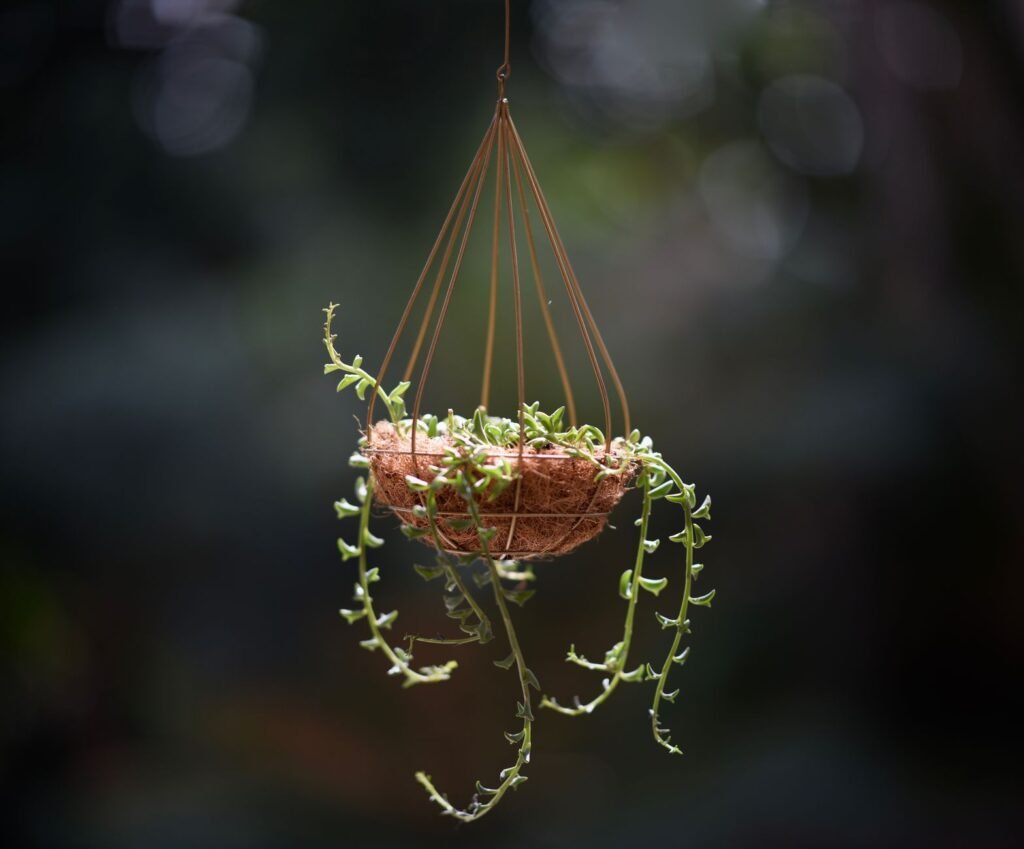
String of dolphins roots easily from stem cuttings that include a few nodes, laid on or lightly pressed into moist, fast draining succulent soil. Keep the cuttings in bright, indirect light and mist the soil surface rather than soaking it until roots form. Single leaves can root too, but more slowly and less reliably.
Where roots form on a string of dolphins stem
String of dolphins, sold as Senecio peregrinus and classified as Curio × peregrinus, is a hybrid of string of pearls and the candle plant. Its curved leaves with two small points look like leaping dolphins. It inherited the trailing habit of string of pearls, and it propagates the same way.
The key is the node, the small bump where each leaf joins the stem. Those are the points where new roots emerge. A stem section with several nodes touching soil can root at each one, while a bare length of stem between leaves has nothing to root from. Plan your cuts so every piece carries several nodes.
Taking and preparing string of dolphins cuttings
- Choose healthy, plump strands with no soft or shriveled leaves, ideally from a plant that is putting out fresh growth.
- With clean scissors, cut a tip section a few inches long. North Carolina State Extension suggests 3 to 5 inch cuttings for string of pearls, one of the parent plants, which works well here too.
- Pull the dolphin-shaped leaves off the lowest inch of stem so a few nodes are bare.
- Many succulent growers leave the fresh cut to air dry briefly before planting so it can callus and seal.
- Fill a small pot that has drainage holes with a gritty cactus and succulent mix, and moisten it lightly.
- Press the bare nodes into the surface or cover them lightly with soil, leaving the leafy part on top.
Several cuttings in one pot will give a fuller plant much sooner than a single strand.
Soil pinning versus a jar of water
There are three common ways to root string of dolphins, and each suits a different situation.
| Method | How it works | Tradeoff |
|---|---|---|
| Cuttings in soil | Nodes pressed into moist succulent mix | Most reliable, roots already suited to soil |
| Pinning to the parent pot | A trailing strand is laid on soil while still attached | Slower to separate, very low risk |
| Water rooting | Nodes sit in a jar of water, leaves above the surface | Easy to watch, but roots must adjust after moving to soil |
Pinning is the gentlest option. Lay a long strand across the soil surface of the parent pot or a neighboring pot, pin the nodes against the mix with an opened paper clip shaped into a U, and cut it free once it has rooted. Leaf propagation, where a single leaf rests on soil, is slower and less dependable, according to NC State.
Watering new cuttings without rotting them
Overwatering kills more cuttings than anything else. NC State warns that too much water causes root rot in string of pearls, and the University of Wisconsin suggests misting the soil surface to avoid overwatering until roots are established. Keep the mix barely damp, never soggy, and empty any water that collects in the saucer.
Give the pot bright, indirect light, which string of dolphins prefers along with some gentle morning sun. Harsh afternoon sun can scorch cuttings that have no roots yet. Rooting speed varies with warmth and light. If a strand stays put when you lift it lightly by its leaves, roots have taken hold, and new dolphin leaves appearing at the strand ends confirm it. From then on, water when the soil has mostly dried, treating it like the parent plant. The same approach works for string of turtles and string of bananas, which trail and root in a similar way.
Keeping cuttings away from pets and small children
NC State lists string of pearls, one parent of this hybrid, as toxic, noting that eating the leaves can cause vomiting and diarrhea and that the sap can irritate skin. Because string of dolphins shares that parentage, treat it with the same care. Anyone with sensitive skin should handle the strands in gloves, everyone should scrub their hands once the snipping is done, and the rooting pots belong on a high shelf out of reach of cats, dogs and curious toddlers.
Frequently asked questions
How can I tell when string of dolphins cuttings have rooted?
There is no fixed timeline, since warmth, light and moisture all change the pace. Cool rooms, low light and soggy soil slow things down. Test by tugging gently on a cutting. Resistance means roots have formed, and fresh growth at the tips is the clearest sign the cutting has taken.
Why are my string of dolphins cuttings shriveling?
Some shriveling is normal while a cutting has no roots, since it lives on water stored in its leaves. If the leaves turn mushy or the stem blackens at the soil line, that points to too much water. Let the soil dry more between mistings and improve drainage.
Can a string of dolphins cutting grow into a full hanging plant?
Yes. Plant several rooted cuttings together in one pot for a fuller look, and pinch the tips occasionally to encourage branching. Once roots are established and new growth appears, move it to a hanging basket where the strands can trail freely in bright, indirect light.
How do you care for string of dolphins?
Give it bright, indirect light, a gritty cactus mix and a pot with drainage holes. Water when the soil has mostly dried, but do not leave it bone dry for long, since NC State Extension notes its parent, string of pearls, suffers from overwatering yet should never dry out completely. Keep it out of reach of pets.
Is string of dolphins a succulent?
Yes. String of dolphins is a trailing succulent that stores water in its thick, curved leaves. NC State Extension describes its parent, string of pearls, as a succulent vine, and both grow best in a gritty cactus mix with careful watering rather than soil that stays wet.