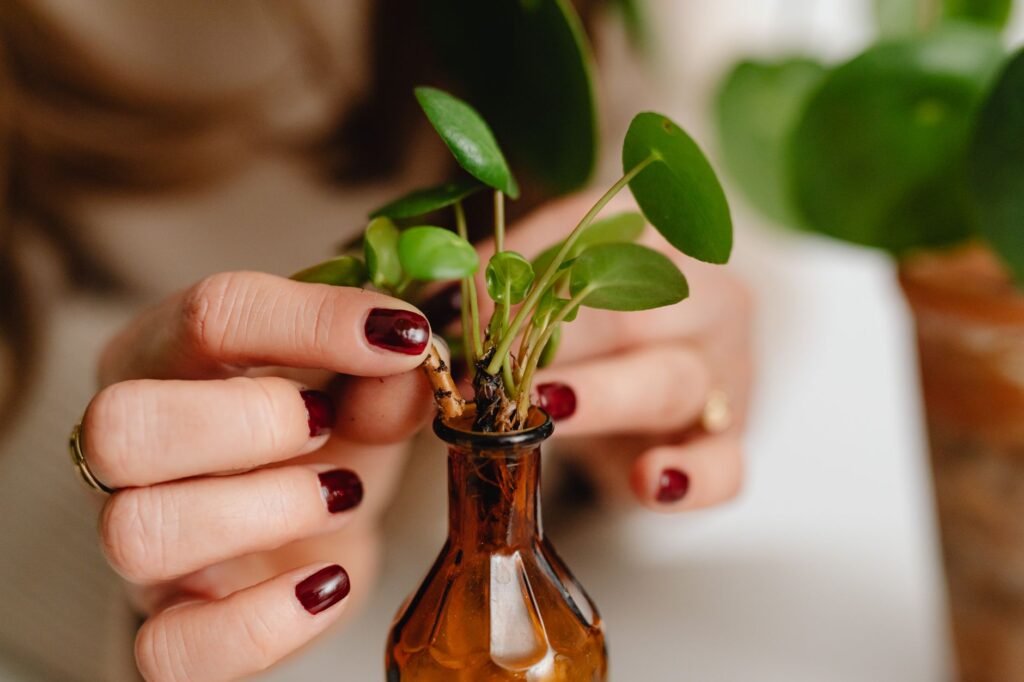
Snip a few inches of healthy vine with several leaves, press or lay it on moist, well draining soil, and keep it warm and humid in bright indirect light until new growth appears. A single Peperomia prostrata leaf can also root, though it usually lags behind a vine section, so stem pieces fill a pot sooner.
Where string of turtles forms new roots
String of turtles is Peperomia prostrata, a small trailing plant with round, patterned leaves that look like tiny shells. Its NC State Extension plant profile gives its native range as the wet tropical areas of Ecuador and says it prefers bright, indirect light, average to high humidity and temperatures around 68 to 75°F.
The key for propagation is the node, the spot along the stem where each leaf attaches. Roots grow from these nodes, and on this plant they appear readily when a node sits against damp soil. A bare stretch of stem between leaves is much less likely to root. When you cut, make sure every piece carries several leaves and nodes.
Laying string of turtles stem cuttings flat on soil
- Choose firm, healthy vines with no soft or yellow sections, and cut with clean scissors.
- Cut pieces a few inches long, each with several leaves along the stem.
- Fill a small, shallow pot with a light, well draining potting mix and moisten it without making it soggy.
- Lay each piece flat across the surface so several nodes touch the soil, or push one cut end just under the surface.
- Pin the stems gently with bent wire or a hairpin if they keep lifting off the soil.
- Tent the pot loosely under a clear plastic bag or humidity dome to trap moisture, and lift it for a while every day or two so fresh air reaches the turtle vines.
- Place the pot where bright light reaches it but hot sun never shines directly on the cutting.
Several stems laid in one pot give you a full looking plant faster than a single cutting.
Rooting single string of turtles leaves
A single leaf with a short piece of its stalk can also become a new plant. Press the stalk end into damp mix so the leaf stands upright or leans against the soil, then treat it the same way as the stem cuttings. This is useful when leaves have fallen off during repotting, or when you want as many new plants as possible from a small mother plant.
Leaf cuttings are slower. Roots form first, and a new shoot can take noticeably longer to emerge where the leaf stalk meets the soil. Mist lightly or keep the dome on so the leaf does not shrivel before it roots, but watch for mold on the soil surface.
Comparing soil, water and leaf methods for string of turtles
| Method | How it works | What to watch for |
|---|---|---|
| Stem cuttings on soil | Nodes root directly into damp mix | Soggy soil can rot the stems |
| Stem cuttings in water | Stem sits in a small glass with the leaves above the waterline | Roots must adjust again once moved to soil |
| Single leaves on soil | Leaf stalk pressed into moist mix | Slowest method, and leaves can shrivel in dry air |
If you root the vines in a jar of water instead, pour it out and refill it every few days, then pot the cuttings once short roots show and keep the mix a little damper for the first weeks.
Caring for string of turtles once the cuttings take
If a vine resists a light pull, or a fresh round leaf opens at a stem tip, roots have formed. Remove the cover for good at that point and let the plant adjust to room air gradually. Keep the mix evenly moist but never waterlogged, since this plant is susceptible to overwatering even though it likes steady moisture.
Growth is slow, and a mature plant trails only about a foot. Patience beats fussing. NC State lists it as non toxic to cats and dogs, so it is a good pick for a pet household. String of dolphins and string of bananas are unrelated trailing succulents with their own routines.
Frequently asked questions
How long does string of turtles take to root?
Stem cuttings usually show roots within a few weeks when kept warm, humid and in bright indirect light, while single leaves take longer. Cooler rooms and dry air slow things down. A gentle tug that meets resistance or a new leaf at the tip tells you the cutting has rooted.
Why are my string of turtles cuttings turning mushy?
Mushy, dark stems nearly always mean too much water or too little airflow. Let the soil dry slightly, lift the plastic cover more often, and remove any soft pieces. Use a lighter, well draining mix and a pot with a drainage hole, and restart with firm healthy cuttings if the rot spreads.
Can I propagate string of turtles in water?
Yes, stem cuttings can root in a small glass of water with the leaves kept above the waterline. Change the water every few days. Water roots have to adjust to soil, so move the cuttings once short roots form and keep the mix slightly damper than usual for the first few weeks.
Is string of turtles a succulent?
Partly. NC State Extension describes its small, round leaves as succulent, and they hold some water, but Peperomia prostrata is a tropical plant that prefers evenly moist soil, bright indirect light and average to high humidity. Treat it more like a humidity loving houseplant than a desert succulent, and don't let it dry out for long.
How do I repot string of turtles?
Move it to a slightly larger pot with a drainage hole and fresh, well draining mix, setting it at the same depth, but only once roots fill the old pot, since NC State notes it does well pot bound. Lift it by the root ball rather than the trailing vines, then water lightly.