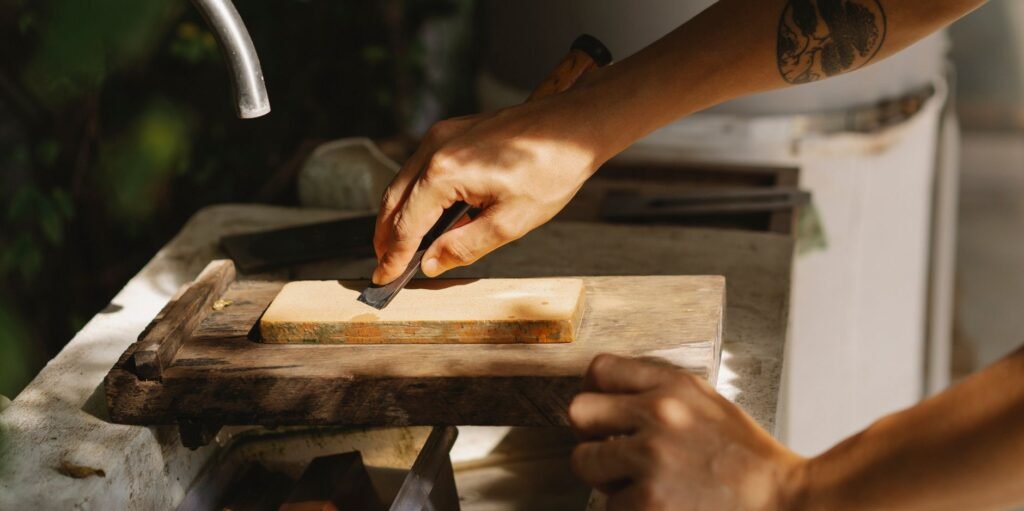
Sharpen a kitchen knife by grinding each side of the edge against a whetstone at a steady angle, coarse side first, until a tiny burr forms, then refining on the fine side. A honing rod between sharpenings keeps the edge aligned, but it removes almost no metal, so it cannot fix a truly dull blade.
Honing a knife is not the same as sharpening it
The two words get used as if they mean the same thing. They do not. Shun, the Japanese knife maker, puts it this way on its guide to sharpening versus honing. Honing maintains the edge by realigning it, while sharpening restores a worn edge by removing a small amount of metal.
In daily use, the thin edge rolls over slightly. A few passes on a steel push it back into line, and the knife feels sharp again. Eventually the edge itself wears down, and no amount of honing helps. That is when you sharpen. The same maker notes that some cooks hone daily and others weekly, depending on how much they use the knife.
Finding the right edge angle for your knife
The angle is measured between the blade and the stone on each side. Japanese style knives are generally ground thinner than German style ones. Shun’s own FAQ says its knives are sharpened to 16 degrees per side and contrasts that with the steeper edges common on German style knives.
Your knife maker’s support page usually lists the factory angle, and matching it means less metal to remove. To hold an angle steady without a guide, color the edge bevel with a permanent marker, make a few strokes, and look. If the ink is gone evenly from the whole bevel, your angle matches. Ink left at the very edge means you are too low, and ink left at the shoulder means you are too steep. A clip on angle guide that rides along the spine is another option while you build the habit.
Whetstone sharpening, stroke by stroke
- Prepare the stone according to its instructions. Some are soaked in water, others only need a splash on the surface.
- Set it on a damp towel or a rubber base so it cannot slide, coarse side up.
- Hold the knife at your chosen angle and push the edge across the stone as if slicing a thin layer off the top, working from heel to tip.
- Repeat on the same side until you can feel a slight burr, a rough lip of metal, along the opposite side of the edge.
- Switch sides and repeat until the burr flips back.
- Turn the stone to the fine side and repeat with lighter pressure, alternating sides as you go.
- Finish with a few light passes on a honing rod or a leather strop, then rinse and dry the blade.
Grit numbers on stones run lower for coarse and higher for fine. A two sided stone covers most home kitchens. Keep your fingertips on the flat of the blade, away from the edge, and move slowly until the motion feels natural.
Pull-through sharpeners, electric models and pro services
| Method | Skill needed | Trade off |
|---|---|---|
| Whetstone | Moderate, improves with practice | Best control over angle and finish |
| Manual pull-through | Very little | Fixed angle may not match your knife |
| Electric sharpener | Little | Fast, but removes metal quickly if overused |
| Professional sharpening | None | Needs a trip or mail in, check local options |
Some knife makers offer their own sharpening service, so check the warranty page before paying someone else.
Testing the edge on paper and a tomato
Hold a sheet of printer paper by one corner and slice down through it. A sharp knife cuts cleanly. A dull spot snags or tears, which shows you exactly where to go back to the stone.
A ripe tomato is the kitchen test. A sharp blade breaks the skin with its own weight. Keep the edge longer by cutting on wood or plastic boards rather than glass, stone or ceramic, and wash by hand. Shun recommends against the dishwasher, where knives get knocked around and exposed to harsh detergent.
Frequently asked questions
How often should you sharpen kitchen knives?
It depends on how often you cook and what you cut. Many home cooks sharpen a few times a year and hone more often in between. The better rule is to sharpen when honing no longer brings the edge back and the knife starts crushing tomatoes or sliding off onion skins.
Can you sharpen a serrated knife?
Yes, but not on a flat stone the usual way. Serrated edges are sharpened one scallop at a time with a tapered sharpening rod, working only on the beveled side. Because they stay useful longer than smooth edges, many people send serrated bread knives to a professional when they finally dull.
Do you need to soak a whetstone before using it?
Only some types. Many traditional water stones need soaking, while others are designed to be used with a splash of water, and some stones are meant for oil instead. Follow the instructions that came with your stone, because using the wrong liquid can clog or damage the surface.
How do you sharpen a knife with a rod?
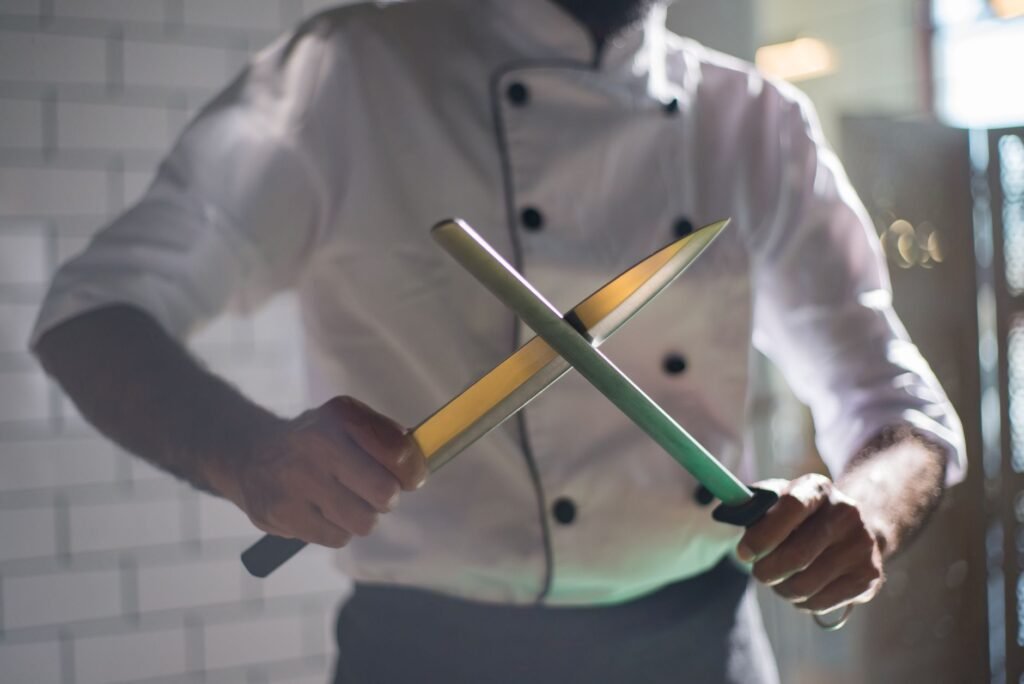
Rest the rod's tip on a cutting board, hold it upright, and draw the blade down and across it from heel to tip at the knife's edge angle, alternating sides. A smooth steel rod only realigns the edge. Ceramic and diamond coated rods remove a little metal, so they can touch up a mildly dull knife.
What is a whetstone?
A whetstone is a sharpening stone that grinds a fresh edge onto a blade. The name comes from whet, an old word meaning to sharpen by rubbing, not from water, although many whetstones are used with water or oil. Many have a coarse side for reshaping a dull edge and a fine side for refining it.