
Cover graphic by KnackDaily.
Keep them in a single layer in a paper lined container with the lid resting on rather than sealed, and let them warm up inside that closed container before serving. The shells sweat whenever cold chocolate meets warm air, so the goal is to make the container take the condensation instead.
Condensation is the whole problem
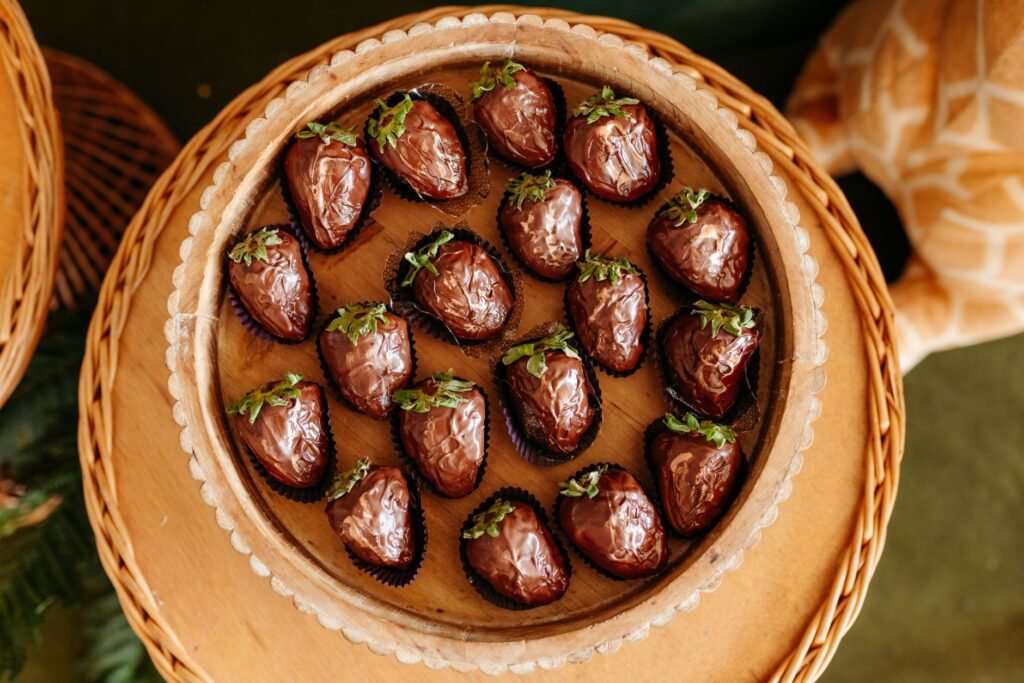
A dipped strawberry is a standoff between two materials that want opposite conditions. The chocolate is a set matrix of cocoa butter crystals that stays glossy only while its temperature holds steady, and it repels water completely. The berry inside is around nine tenths water and keeps slowly giving that water up. Everything that goes wrong follows from those two facts.
Pull a cold tray straight into a warm kitchen and moisture in the room air condenses on the chilled shells within a minute. That surface water dissolves a little of the sugar in the chocolate, then evaporates and leaves the sugar behind as a dull gray crust. Confectioners call it sugar bloom. Swing the temperature repeatedly and you get the other version, fat bloom, where cocoa butter migrates outward and recrystallizes in pale streaks. Meanwhile the berry is weeping juice on the inside of the shell, softening the seal from below. Steady temperature and controlled humidity are the whole job.
Setting up a tray that stays dry
- Let the chocolate set fully at cool room temperature before anything goes in a container. Warm chocolate pressed against a surface loses its shine there.
- Line a shallow box or container with a paper towel or parchment to catch any weeping.
- Arrange the berries in one layer with a little space between them, stems up.
- Rest the lid on top without clicking it shut. Trapped humidity is as bad as an open tray.
- Put the container on a middle shelf of the refrigerator, away from the door and away from strongly smelling leftovers.
- To serve, take the whole closed container out and leave it on the counter for twenty to thirty minutes. Condensation forms on the container rather than the chocolate.
- Open it only once the box no longer feels cold to the palm.
Where they could go, and what happens
| Location | Result | Use when |
|---|---|---|
| Cool room, single layer, loosely covered | Best gloss and best fruit texture | Serving within several hours |
| Refrigerator, lined box, lid resting on | Good, slight dulling of the shine | Made a day ahead |
| Refrigerator, sealed airtight | Wet shells and condensation inside | Not recommended |
| Plastic wrap directly on the berries | Wrap sticks and peels chocolate away | Never |
| Freezer | Fruit collapses, shell separates on thawing | Only if eating them semi frozen |
A warm room changes the math. If the kitchen is hot, the refrigerator wins even at the cost of some gloss, because a softening shell will slump and fingerprint long before dullness becomes the bigger problem.
The mistakes that ruin a tray
Stacking is the most common and the most expensive. A second layer cracks the shells underneath, and cracked shells let berry juice out onto everything below, so the bottom row sits in syrup by morning.
Dipping damp berries is the mistake that happens before storage even begins. Water and melted chocolate do not mix, a few drops make the chocolate seize into a grainy mess, and any water trapped between fruit and shell becomes the spot where mold starts first. Wash the berries hours ahead, dry each one, and let them come to room temperature before dipping, because cold fruit shocks the chocolate into a dull finish.
The last one is unwrapping too soon. People pull the container out, open it immediately, and watch the shells fog over while they set the table. Twenty quiet minutes with the lid on fixes that entirely.
Telling tired from spoiled
Gray dusty patches and pale streaking are bloom. They look disappointing and taste completely normal, so serve them anyway if that is what you have.
What actually signals the end is the fruit. Pooled red syrup in the bottom of the container, a berry that gives soggily under light pressure, a shell that has parted from the fruit and slides, or a fermented smell at the stem all mean their time is up. Any fuzzy growth at the stem end means the whole tray gets discarded rather than picked over.