
Wash with warm water and a little dish soap on a microfiber cloth, moving along the brushed lines rather than in circles, then dry with a second cloth in the same direction. Soap handles the oil in fingerprints, the drying pass removes the water marks, and the grain direction removes the streaks.
Follow the grain or you will see every stroke
A stainless panel is not smooth. The brushed finish is thousands of shallow parallel grooves, and they run one way on each panel, usually horizontally across a fridge door and often vertically on a dishwasher front. Wiping in circles drags soil across the grooves and leaves it sitting in them, which reads as haze from an angle even when the panel feels clean.
Look at the surface in raking light before you start, find the direction of the lines, and keep every stroke parallel to them. This single habit fixes more streaking complaints than any product.
The invisible layer doing all the work
Stainless resists rust because chromium in the alloy reacts with oxygen and forms an extremely thin chromium oxide film across the surface. Scratch it and it rebuilds itself from the air. That self repair is the entire point of the material.
Chloride ions interrupt it. Bleach, chlorinated bathroom sprays, pool chemicals and even salty food left sitting on a surface will break the film down in spots, and once oxygen cannot reach the bare metal underneath, corrosion digs in as small dark pits. Those pits are permanent. This is why a stainless sink can look flawless for years and then develop rust freckles the week after somebody leaves bleach in it overnight.
The routine that keeps panels even
- Knock off crumbs and grit with a dry cloth first so nothing gets dragged along the grain.
- Wring a microfiber cloth in warm water with a few drops of dish soap. Fingerprints are skin oil, and water without a surfactant simply pushes them around.
- Wipe in long parallel passes following the brush lines, working top to bottom so drips land on uncleaned surface.
- Rinse the cloth, wipe again with clean water to clear soap residue, which is a common cause of a dull film.
- Dry immediately with a fresh cloth in the same direction. Hard water evaporating on its own leaves mineral spots that look like dirt.
- Optional finishing pass. A drop of mineral oil or a dedicated stainless polish on a cloth evens out the sheen and slows the next set of fingerprints. Use very little and buff it out.
Safe versus damaging on stainless
| What you use | Effect on the steel |
|---|---|
| Dish soap, warm water, microfiber | Removes oil and soil, leaves the passive layer intact |
| Diluted white vinegar | Good for hard water spots. Rinse and dry after, never leave it to sit |
| Bleach or chlorinated cleaners | Chloride breaks the protective film and causes permanent pitting |
| Steel wool or a wire brush | Embeds carbon steel particles that rust in place, so the panel looks like it is rusting from within |
| Abrasive powder cleanser | Cuts across the grain and leaves a scarred patch that never blends back in |
| Oven cleaner on the exterior | Strongly caustic, discolors and stains stainless trim |
| Letting salty or acidic food dry on the surface | Slow chloride attack. Wipe spills the same day |
Black stainless and fingerprint resistant fronts play by other rules
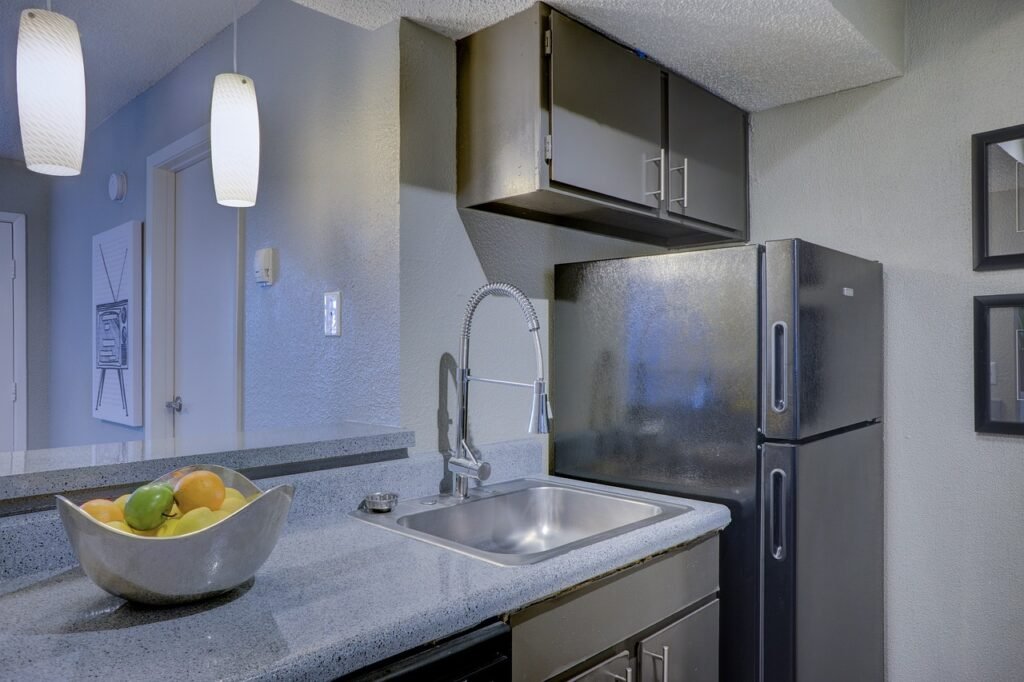
Many current appliances are not bare steel at the surface. Black stainless is usually a colored coating or a laminated film over the steel, and fingerprint resistant finishes carry a clear coat designed to reduce oil transfer. On both of these, the metal underneath never gets touched by your cloth.
That rules out the whole abrasive category, including cream polishes and scouring pads, because a scratch in the coating exposes a different color underneath and cannot be buffed out. Oil based stainless polish is also a poor idea on these panels, since it tends to pool and leave shiny patches instead of soaking evenly. Soap, water and a dry cloth is the full toolkit, and the manufacturer manual will say so if you check it before reaching for anything stronger.