
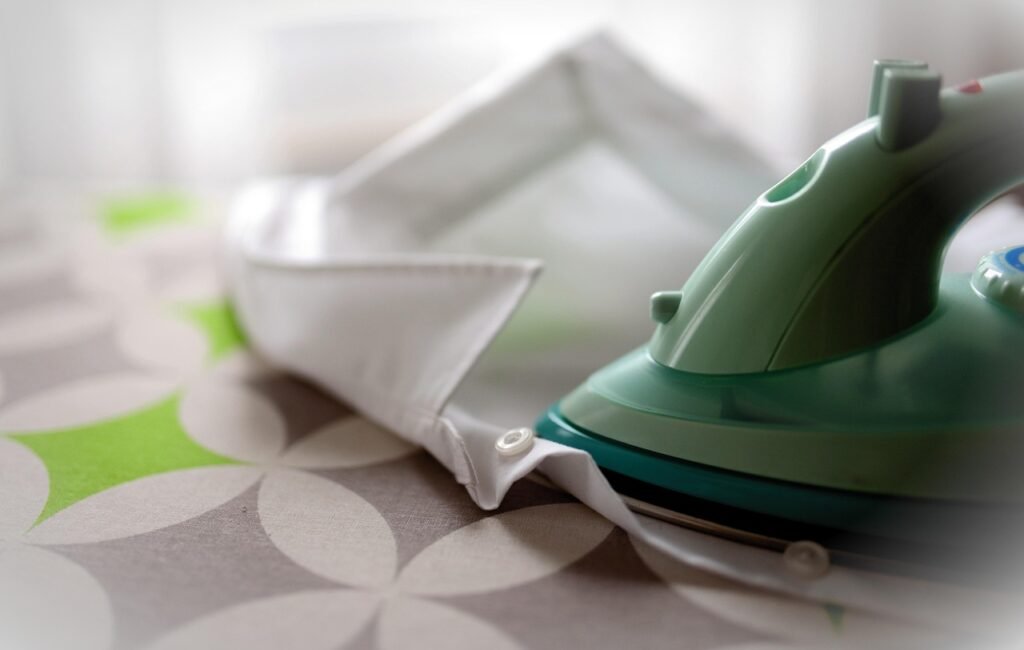
Freeze the garment until the wax turns brittle, crack it and lift off every solid flake, then melt the rest into a stack of plain paper with a warm iron. Move to a clean sheet on each pass. Any leftover candle color is a separate job, handled after the wax leaves.
Why wax behaves nothing like a liquid spill
Paraffin is a solid hydrocarbon. It has no meaningful attraction to water, so no amount of soaking, rinsing or detergent does anything useful to it. What makes wax stick is purely mechanical. It arrives molten, flows into the spaces between and around individual fibers, and then hardens there, forming a cast of the weave that is locked in place by shape rather than by chemistry.
That physical grip is also the weakness. Paraffin has a narrow personality: it is rigid when cold and runny when warm, with very little in between. Chill it and it becomes glassy enough to fracture under thumb pressure, releasing most of the deposit in pieces. Warm it and it goes back to a thin liquid that a dry absorbent material will pull straight out of the fabric by capillary action. Heat is the tool for this stain, not the enemy, provided you always give the liquid somewhere better to go.
Cold first, heat second
- Bag the garment and put it in the freezer, or press a sealed bag of ice against the patch, until the wax is hard and dull rather than waxy to the touch.
- Flex the fabric to shatter the deposit, then work a spoon edge or a butter knife from the rim of the patch in toward its middle. Scraping inward keeps the flakes from scattering onto clean cloth.
- Check your care label for a safe iron temperature, and test that setting on a hidden hem. Many synthetics soften or glaze at the heat paraffin needs, and a shiny scorched patch cannot be undone.
- Sandwich the stained area between plain uncoated paper, above and below, with no printing on it.
- Press with a warm dry iron for a few seconds at a time, lifting often. Each time the paper shows a translucent patch, slide clean paper into place. Used paper simply gives the wax back.
- Stop when fresh paper stays dry, then launder normally and let the garment air dry.
The steps that free the wax and the ones that weld it in
| Do this | Do not do this |
|---|---|
| Chill the wax until it fractures | Pick at soft wax and smear it wider |
| Use dry, unprinted paper as the wick | Iron directly on the fabric with nothing above it |
| Change paper on every pass | Reuse a saturated sheet, which reprints the wax |
| Confirm the iron setting on an inside hem | Guess the temperature on a synthetic blend |
| Remove all wax before touching the color | Attack the dye while wax still coats the fibers |
The colored candle problem
A white candle usually ends at the ironing step. A red or green one leaves a second stain underneath, because the dye that colored the wax has now been carried into the fibers by melted paraffin acting as a solvent. Ironing a colored deposit before the bulk is scraped away drives that dye outward, which is how a small drip becomes a large pink blush.
Handle the color only after fresh paper stops picking anything up. Dab rubbing alcohol on the mark from the outer edge inward, blotting onto a cloth underneath, then launder. On whites, an oxygen bleach soak is the gentler follow up. If you use chlorine bleach instead, keep it isolated from ammonia products, including most spray glass cleaners, because those two release chloramine gas that burns the airways in a closed laundry space.
Heat earns its place in this repair, but only where the wax has an exit. A dryer offers none. Warm tumbling melts any residue into deeper fiber and fixes stray dye at the same time, so hang the garment up and inspect it dry before you let a machine finish the job.